Classification of H-beam
Jun 10, 2021
There are many specifications of H-beam products, and the classification methods are as follows. (1) According to the flange width of the product, it is divided into wide flange, middle flange and narrow flange H-shaped steel. The flange width B of wide flange and middle flange H-shaped steel is greater than or equal to the height H of the web. The width B of the flange of the narrow flange H-shaped steel is approximately equal to one-half of the height H of the web. (2) Divided into H-shaped steel beams, H-shaped steel columns, H-shaped steel piles, and extremely thick flange H-shaped steel beams according to product usage. Sometimes parallel leg channel steel and parallel flange T-shaped steel are also included in the scope of H-shaped steel. Generally, narrow flange H-shaped steel is used as beam material, and wide-flange H-shaped steel is used as column material. According to this, it is also called beam-shaped H-shaped steel and column-shaped H-shaped steel. (3) According to the production method, it is divided into welded H-beam and rolled H-beam. (4) Divided into large, medium and small H-beams according to size specifications. Generally, products with a web height H above 700mm are called large, 300-700mm are called medium, and those with a web height H of less than 300mm are called small. By the end of 1990, the world's largest H-beam web was 1200mm in height and flange width was 530mm.
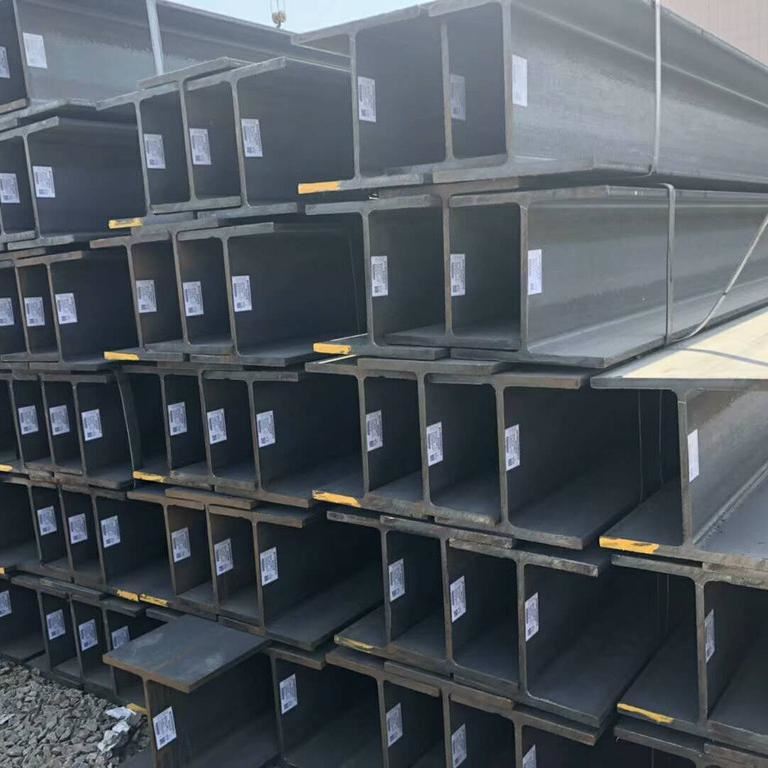
Internationally, the product standards of H-beams are divided into two categories: the imperial system and the metric system. The United States, Britain and other countries adopt the imperial system, while China, Japan, Germany and Russia adopt the metric system. Although the units of measurement used in the imperial system and the metric system are different, for H-beams, most of them use four sizes to indicate their specifications, namely: web height h. Flange width b, web thickness d and flange thickness t. Although countries around the world have different ways of expressing H-beam size specifications. However, the size and tolerances of the products produced are not much different.