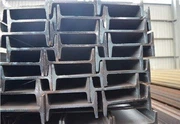
What is carbon structural steel
Apr 20, 2021
Production Process
According to the quality requirements of steel grade and steel, the smelting of alloy structural steel can use oxygen top blowing converter, open hearth furnace, electric arc furnace; or add electroslag remelting and vacuum degassing. The ingot can be continuous casting or die casting. The steel ingot should be slowly cooled or hot sent for forging or rolling. When the steel ingot is heated, the temperature should be uniform and the holding time should be sufficient to improve the segregation defects and avoid uneven deformation during forging and rolling; the steel after forging and rolling should be small in size, especially carburizing with a carbon content of about 0.2% Steel should be cooled quickly above 600°C to avoid aggravating the band structure; for forgings with larger cross-sections, measures should be taken to eliminate internal stress and white spots. Quenched and tempered steel should be quenched into martensite structure as much as possible, and then tempered into sorbite structure; during the carburizing process of carburized steel, the concentration gradient of the cemented layer should not be too large, so as to avoid continuous network on the grain boundary of the cemented layer Carbide; Nitrided steel must be heat treated to obtain the required properties, and then finally processed to be nitrided. After the nitriding treatment, except for grinding and removing the brittle and thin "white layer", no processing is required. Classification a kind of carbon steel. The carbon content is about 0.05% to 0.70%, and individual can be as high as 0.90%. It can be divided into two types: ordinary carbon structural steel and high-quality carbon structural steel. The former contains more impurities and is low in price. It is used where performance requirements are not high. Its carbon content is mostly below 0.30%, and its manganese content does not exceed 0.80%. It has low strength, but has plasticity, toughness and cold deformation properties. it is good. Except for a few cases, it is generally used directly without heat treatment. It is mostly made of steel bars, special-shaped steels, steel plates, etc. There are many uses and a large amount. It is mainly used in railways, bridges, and various construction projects to manufacture various metal components that bear static loads, and unimportant mechanical parts and general welded parts that do not require heat treatment. The high-quality carbon structural steel is pure, has less impurities, and has good mechanical properties. It can be used after heat treatment. According to the manganese content, it is divided into two groups: ordinary manganese content (less than 0.80%) and higher manganese content (0.80% to 1.20%). Carbon content is less than 0.25%, mostly used directly without heat treatment, or after carburizing, carbonitriding, etc., to manufacture small and medium gears, shafts, piston pins, etc.; carbon content is 0.25% to 0.60%, typical steel There are 40, 45, 40Mn, 45Mn, etc., which are often quenched and tempered to manufacture various mechanical parts and fasteners. The carbon content exceeds 0.60%, such as 65, 70, 85, 65Mn, 70Mn, etc., which are mostly used as springs. Steel use.
Mechanical properties
This type of steel mainly guarantees the mechanical properties, so its grade reflects its mechanical properties. It is represented by Q+ numbers, where "Q" is the initial Chinese pinyin of the word "yield", and the number represents the value of the yield point. For example, Q275 means the yield point is 275Mpa. If the letters A, B, C, and D are marked after the grade, it means that the quality of the steel is different, and the amount of S and P is reduced in turn, and the quality of the steel is improved in turn. If the letter "F" is marked at the end of the grade, it is rimmed steel, marked with "b" is semi-killed steel, and those without "F" or "b" are killed. For example, Q235-A·F means Class A boiling steel with a yield point of 235Mpa, and Q235-C means Class C killed steel with a yield point of 235Mpa.
Quality score
Carbon structural steel is generally not subjected to heat treatment, but is directly used in the supply state. Generally, Q195, Q215, and Q235 steel have low carbon mass fraction, good welding performance, good plasticity, toughness, and certain strength. They are often rolled into thin plates, steel bars, welded steel pipes, etc., which are used in bridges, buildings and other structures and manufacturing ordinary screws, Nuts and other parts. Q255 and Q275 steels have slightly higher carbon mass fraction, higher strength, better plasticity and toughness, and can be welded. They are usually rolled into section steel, bar steel and steel plate as structural parts and manufacture simple mechanical connecting rods, gears, and couplings. Parts such as knots and pins.